Alarm and monitoring Denver, Colorado
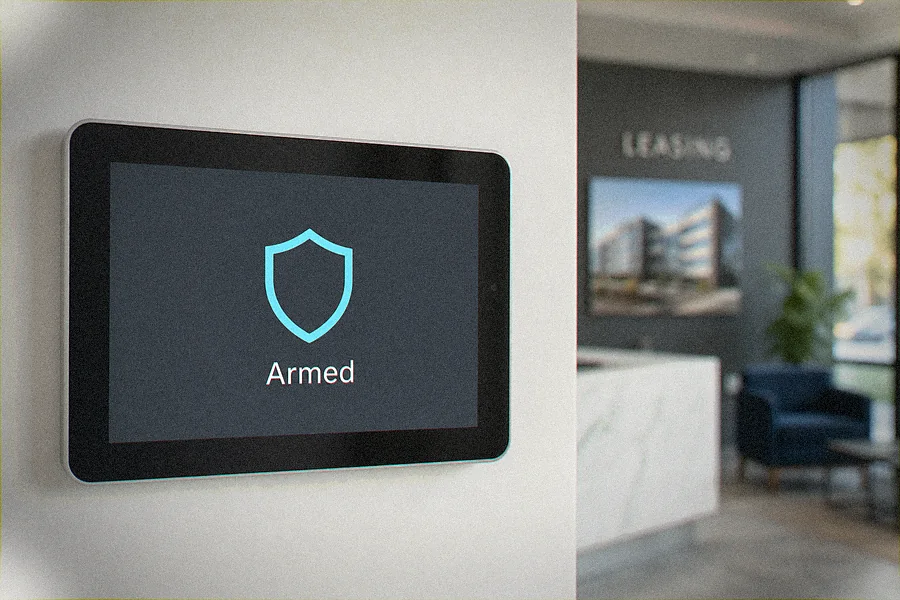
Armed on schedule, monitored around the clock.
Commercial intrusion and environmental alarms with dual-path cellular and IP signaling to a UL-listed central station. Arms itself when the office closes, disarms for the first person in, and tells you about water before the ceiling does.
What we install
Partitions that match how the building is used
Doors, motion and glass break by partition
Leasing office, package room, IT closet and retail suites each on their own partition and schedule, so one tenant closing does not arm another.
Water, temperature and power
Water sensors in mechanical rooms and under head-ends, temperature in IT closets and freezers, and power-loss reporting, all through the same panel and app.
UL central station, dual path
Cellular and IP signaling to a UL-listed central station with open and close reports, so you know who armed and when, and dispatch happens whether or not the internet is up.
Works with
Engineered alongside everything else in the building.
The alarm shares the network and the credentials with access control, so arming follows the last badge out. Camera clips attach to alarm events. One keypad, one app, one monitoring account for the whole property.
- PlatformsAlarm.com, Qolsys
- How it worksArms itself on schedule
- SupportManaged services plan
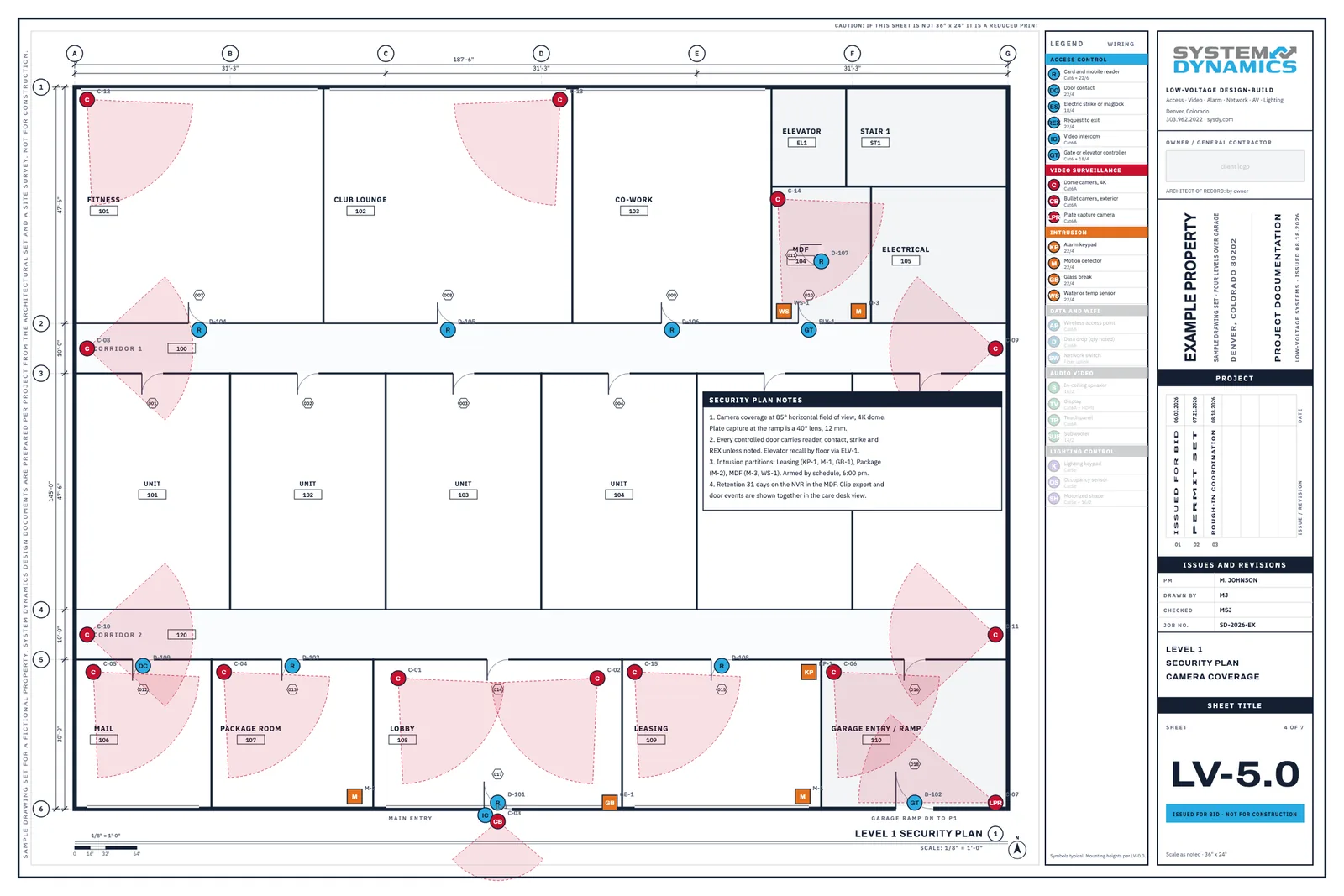 LV-5.0 Security plan with intrusion partitions
Sample sheet. Every project gets its own drawing set.
Which platform fits
Two platforms, one central station, two paths out of the building.
For the app, the automation and the reports
Alarm.com is the layer the owner and the property manager see: arming from a phone, open and close reports, schedules by partition, and the water and temperature alerts that reach the right person.
Every commercial system we install reports through Alarm.com because its reporting is what a manager will actually read.
For the panel, the partitions and the sensors
Qolsys panels carry the partitions, the touchscreen at the staff entry, and encrypted wireless sensors that install cleanly in a finished building.
We specify Qolsys for office, retail, multifamily back-of-house and amenity spaces, with wired zones where the construction schedule allows them.
Cellular and IP, so an alarm has a second path out
The panel sends every alarm over the building network and over cellular at the same time. Either path reaches the UL-listed central station on its own.
Cellular also carries the signal when a power or internet outage is the event, which is when environmental alarms matter most.
What drives cost
What moves the number on an alarm proposal.
Partitions and schedules. Each tenant suite, amenity space or office that arms on its own schedule is a partition with its own keypad or app users. The count of partitions sets the panel and the programming time.
Sensor count and type. Door contacts, motion detectors, glass break and environmental sensors are priced per device. Wired sensors cost more to install and less to maintain; wireless the reverse.
Environmental coverage. Water sensors under head-ends and in mechanical rooms, temperature in IT closets and freezers, and power-loss reporting add devices and add the alerts that prevent the expensive call.
Monitoring. Central station monitoring is a monthly fee per panel, with video verification as an option. It is listed with the managed services plan so the owner sees one recurring figure.
Permits and inspection. Alarm permits and registration with the city carry fees and time. We handle the paperwork and build it into the schedule.
Integration. Arming from the access system, cameras that verify an alarm and lights that come on with it each take programming on both sides.
What the building department and insurer expect
UL listing, permits and false alarm ordinances.
Insurers ask for monitoring by a UL-listed central station, and some ask for a certificate for the installed system. Every system we install reports to a UL-listed station, and we provide the certificate when the policy requires one.
Denver and most Front Range cities require an alarm permit or registration and charge for repeat false alarms. We register the system, train staff on arming and disarming, and set up video verification where the owner wants dispatch to be confirmed first.
Fire alarm is a separate, life-safety system with its own code and contractor. Our intrusion and environmental panels never replace it, and where the two share a monitoring account we coordinate the interface in writing.
Questions
Questions we get on every project
Is this a fire alarm?
No. We install intrusion and environmental alarm systems. Fire alarm is a life-safety system installed by a licensed fire alarm contractor, and we coordinate with them.
Can each tenant arm their own space?
Yes. Partitions give each suite or amenity space its own schedule and users, on one panel and one monitoring account.
What is dual-path signaling?
The panel sends every alarm over the internet and over cellular at the same time, so dispatch happens even when one path is down.
Will the alarm tell me about a water leak?
Yes. Water sensors under head-ends, in mechanical rooms and behind appliances report through the same panel and app as the intrusion system.
Can the system arm itself?
Yes. Schedules arm each partition at close and disarm for the first credential in, and the app shows who armed and when.
Who responds to an alarm?
The UL-listed central station follows the call list and dispatch instructions we set up with the owner, and with video verification they can confirm the event first.